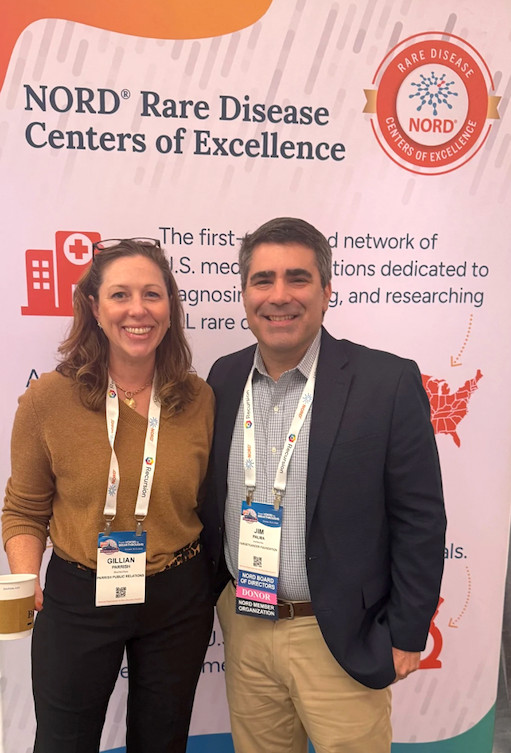
Gillian Parrish, President of Parrish Public Relations and an advisor to the Paying With Our Lives advocacy campaign and TCF CEO Jim Palma at the 2025 NORD Breakthrough Summit in Washington DC.
The first day of NORD’s Breakthrough Summit brought together patient advocates, biopharma leaders, regulators, and rare disease families to tackle the most pressing challenges facing the community. While the summit addressed rare diseases broadly, the lessons resonate deeply for the rare cancer community — from the struggle to access innovative treatments to the need for patient-partnered research models. Here are five themes that emerged throughout the day:
1. We’re not fragile — we’re just rare
Young patients want to be included — in sports, school, life — and treated like kids, not caution tape. They know their limits. Trust them to live fully.
Heard on the ground: “We aren’t glass. Let us play. Let us break our arms. We know what we can and can’t do.“
2. Breakthroughs mean nothing without access
Patients can’t benefit from what they can’t reach. Access needs to be planned, funded, and fought for — starting at development, not after approval.
Heard on the ground: “Compassionate use is a band-aid for individual patients — not a solution for the community.”
3. Mental health is not a luxury — it’s essential
Rare families are exhausted, isolated, and under-supported. Patients and caregivers need integrated, covered mental health care, not just resilience praise. And groups like the National Association for Mental Illness (NAMI) are making this happen by partnering with rare disease advocates to integrate mental health support into treatment.
Heard on the ground: “We are co-creators of the future of medicine but rarely are we asked how we are doing. Pointing to one of five faces on an intake sheet is not mental health care.”
4. Patient voice is evolving from storytelling to strategy
Companies and regulators are involving patients earlier — when their input can actually shift decisions.
Heard on the ground: “It’s not about giving patients a voice. It’s about trusting them enough to act on what they say.”
5. Rare trials are coming home
Clinical trials are finally reflecting the realities of rare disease families: decentralized models, caregiver-informed logistics, and digital tools are expanding access.
Heard on the ground: “Home-based trials aren’t a convenience — they’re a lifeline.”
TCF is proud to be one of the pioneers in this space. Our TCF-001 TRACK trial is currently enrolling 400 patients with rare cancers or cancers of unknown primary. Through a remote consenting process, patients can fully enroll in the TRACK study from their homes, without traveling to a clinical trial site. Enrolled patients and their physicians receive biomarker testing of both tissue and blood, as well as interpretation and treatment recommendations.
Trust Is the Foundation
Across every session, one message was clear: trust is the foundation of progress in rare disease.
Trust means listening when a fifteen-year-old patient says “we know our limits” and designing policies that respect that knowledge. It means believing parents when they describe the mental health toll of extreme caregiving, and funding solutions accordingly. It means FDA regulators and industry sponsors having candid conversations with “handcuffs off” to design better trials. It means biopharma leaders changing endpoints mid-development because patients said pain management mattered more than tumor shrinkage.
The young advocates who opened the summit set the tone: they’re not asking for special treatment or protection from risk. They’re asking to be trusted — to participate in their own care decisions, to take the same chances other kids take, to be seen as experts on their own lives.
This is the same message they delivered on Capitol Hill while advocating for The Give Kids a Chance Act earlier this week. This Act would reauthorize the Food and Drug Administration priority review voucher (PRV) program which allows pharmaceutical companies to expedite FDA review of more profitable drugs in return for developing treatments for rare pediatric diseases. Despite having 190 bipartisan cosponsors, it was cut from the Congressional spending bill earlier this year.
When a patient advocate says “the greatest gift you can give a patient is to make them feel heard, understood, and believed,” she’s not asking for sympathy. She’s asking for trust — trust that transforms how medicines are developed, trials are designed, insurance is structured, and artificial intelligence is integrated into care for all patients with rare diseases.