
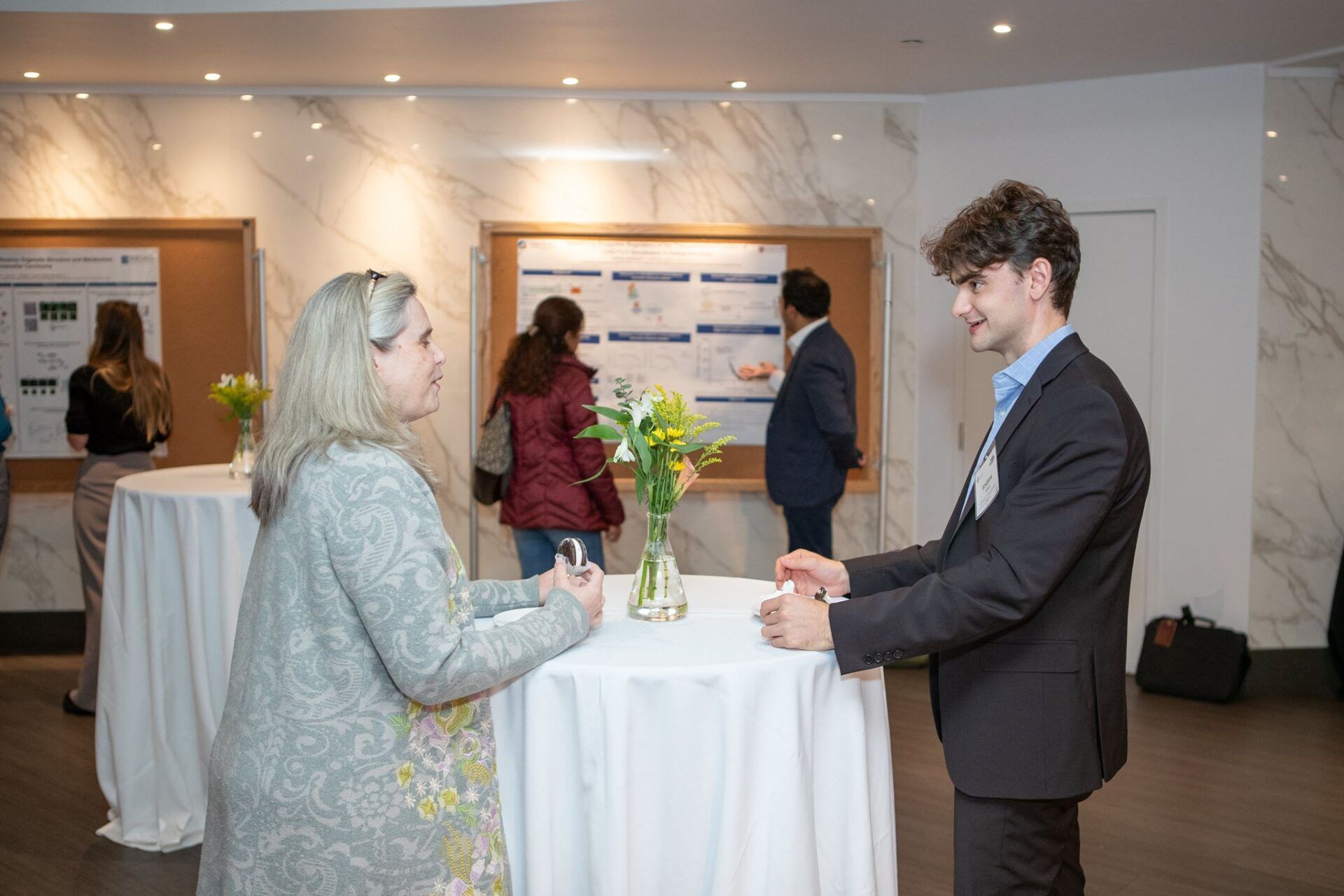
In 2025, I had the pleasure of attending the Think Tank on Advancing Precision Medicine in Rare Cancers as a senior undergraduate. Looking back on my experience ahead of this year’s 5th annual event, I am reminded of the critical impact the diverse range of speakers had on my view of cancer care. To me, the Think Tank presents a unique opportunity not only to address the issues that too often stand in the way of patients with rare cancers receiving the best possible care, but also to celebrate the persistent efforts of research scientists, healthcare professionals, industry leaders, policy advocates, and patients to overcome these roadblocks.
To start the day, the first keynote speaker, Leah Christoforidis, focused the discussion directly on what this mission is about: the patients. Leah spoke about the steps it took for her to receive an accurate diagnosis of a rare kidney cancer called translocation renal cell carcinoma. In sharing how difficult it was to repeatedly tell her story to different physicians, Leah stressed that being an advocate was ultimately essential to building confidence in herself and in her care team, while also allowing her to find a treatment plan that worked for her and to “always be ready” for new challenges.
The scientific portion of the meeting highlighted recent efforts to improve treatment options for patients with rare cancers. It was intriguing to see how teams are working toward a more general framework for treating any type of cancer – even the rarest, “N-of-1” cancers, or cancers unique to a single patient – by looking to characterize the disease in a new way. This framework coincides with recent advancements in genomic sequencing, which has shown that a vast number of genomic disease drivers exist across different cancer types that arise in different locations of the body. This has paved the way for an entirely new way to classify, as well as treat, cancer based directly on its biology rather than its location – an approach known as “tissue-agnostic.”
A prime example of how this knowledge can revolutionize cancer care was brought to the stage in Andrea Cercek, MD’s scientific keynote presentation. She presented a successful phase 2 clinical trial in which a treatment previously approved for rectal cancer with a specific genetic profile was used successfully in other nonrectal solid tumors with the same genetic background. The trial was a hallmark example of the prospect of using precise biological markers to treat a wide variety of previously disconnected tumor types, especially kinds that are rare.
The Think Tank also addressed the current challenges facing both advancements in rare cancer treatment and the widespread adoption of the tissue-agnostic approach in industry, policy, and clinical trial design. However, these challenges were paired with actionable proposals. One proposal highlighted the emerging opportunity for biomarker-driven drug development in rare cancers to create therapies that are effective across tumor types. Another demonstrated how clinical trials can be organized under this new framework through flexible trial designs, helping more patients gain access to novel treatments that share a common target with their specific cancer.
In my eyes, the Think Tank on Advancing Precision Medicine in Rare Cancers is a special opportunity to witness the conversations happening in real time as professionals continue to work toward improving options for patients.
Andrew Venuti is a recent college graduate currently working as a Research Technician at the Brain Tumor Research Center at Massachusetts General Hospital. As a member of the Cahill Lab, he and his team investigate novel treatments for low-grade gliomas harboring IDH mutations, using tumor samples derived directly from patients. Andrew plans to pursue a career in medicine, inspired by his exposure to patients and the critical role research plays in advancing care for rare cancers and beyond.