
What happens when cancer has spread, but no one can say where it first started? For a small but deeply challenging subset of cancer cases, this uncertainty has a name: cancer of unknown primary, or CUP. CUP begins with uncertainty: cancer is present and has spread, but the original site remains unclear because diagnostic clues do not fully point to one known primary cancer.
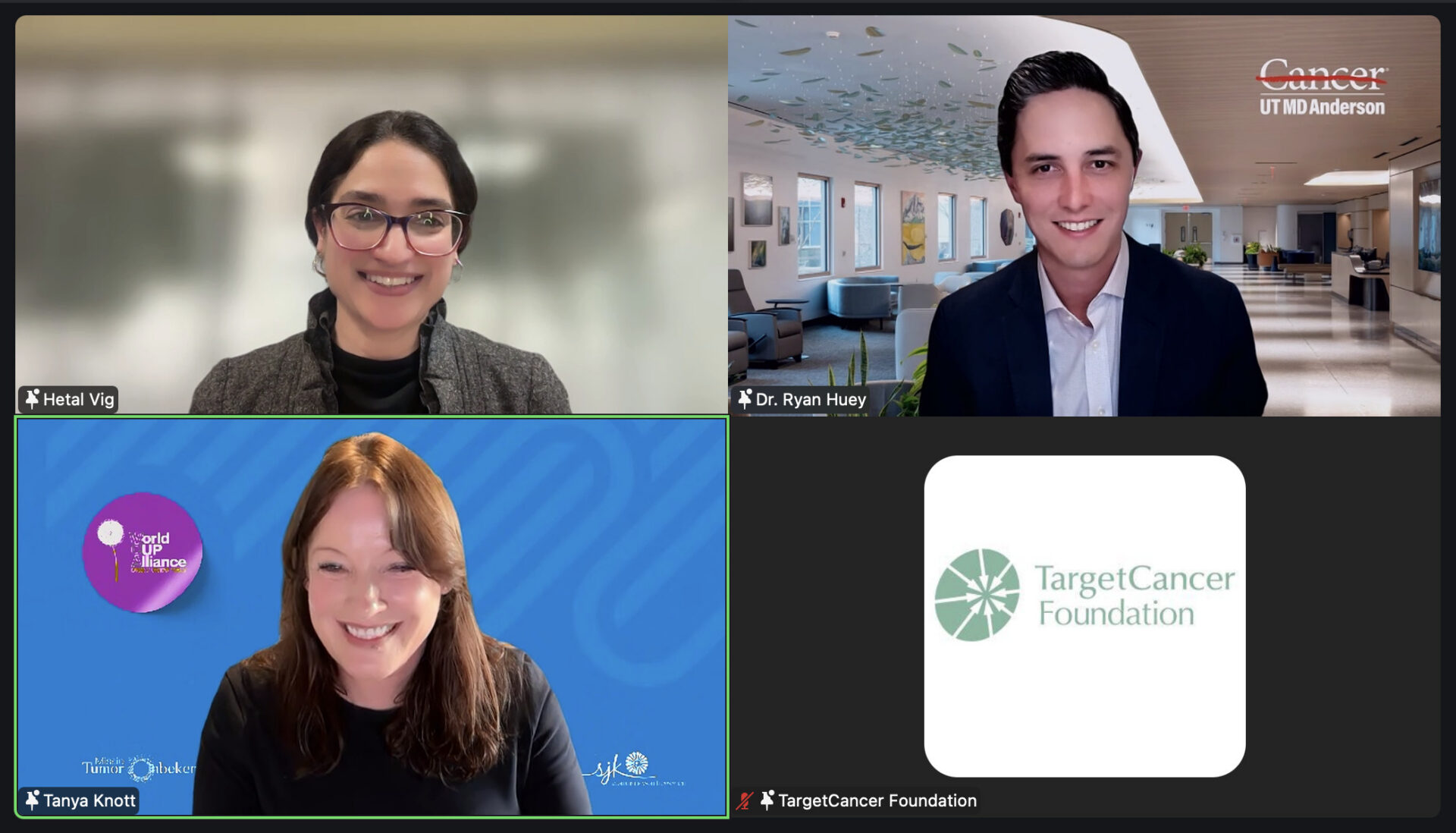
In TargetCancer Foundation’s patient empowerment webinar, Coping with CUP: Navigating the Unknown, Dr. Ryan Huey, a medical oncologist at MD Anderson Cancer Center, and Tanya Knott, founder and director of the Sarah Jennifer Knott Foundation and co-founder of the World CUP Alliance, joined TCF Director of Research and Clinical Engagement Hetal Vig to discuss the clinical and emotional realities of CUP.
Together, they explored why CUP can be difficult to diagnose, the emotional toll of the unknown on patients and caregivers, and why testing, expertise, advocacy, and support can all play an important role in care.
When The Puzzle Pieces Don’t Fit
One of the challenges of CUP is that it often does not follow the more familiar path of a cancer diagnosis. In many cancers, a tumor is identified in a specific organ, biopsied, classified, and treated based on where it began.
As Dr. Huey explained, CUP is distinct because the available information does not always point clearly in one direction. Imaging may show cancer in one or more areas of the body, while pathology may suggest something different. In other cases, the cancer may resemble a certain tumor type under the microscope, but scans do not reveal a mass where clinicians would expect the cancer to have started. This can leave patients and families feeling as though the “puzzle pieces” do not fit together neatly.
Patients may spend weeks or months going through tests, referrals, biopsies, scans, and possible explanations before CUP is named. This time is not insignificant: clinical symptoms may continue to build as patients and families navigate a lengthy diagnostic odyssey, adding urgency to an already overwhelming experience. And, as the panelists’ conversation made clear, this uncertainty is not just a medical challenge, but also an emotional one.
The Emotional Weight of Uncertainty
The uncertainty associated with CUP shapes nearly every part of the patient and caregiver experience, and, as Tanya explained, the uncertainty can begin before CUP is even named. Many patients and families may already be navigating vague symptoms, fear, waiting, and the sense that something is being missed.
That uncertainty can leave patients feeling caught in-between: between possible diagnoses, between care teams, and between the need for answers and the urgency to begin care. Tanya described how patients may feel as though they do not clearly belong to one pathway while clinicians are still trying to determine what the cancer most resembles.
One of the most difficult questions this uncertainty raises is also one of the most human: how can treatment move forward if no one knows where the cancer started? As Tanya emphasized, not knowing can create a profound sense of powerlessness. Patients and caregivers are asked to make decisions, absorb information, and plan for care while still living with unanswered questions. With a diagnosis shaped by uncertainty, helping patients feel informed, supported, and less alone is an essential part of care.
Finding Support and Direction In The Unknown
While CUP can feel isolating, the webinar highlighted several key takeaways that may help patients and caregivers move forward with more direction:
The Value of Clinical Expertise
One important theme was the value of clinical expertise. Because CUP is rare and complex, second opinions, pathology review, and CUP clinical experts can help patients and families better understand possible treatment options. A second opinion may involve another specialist reviewing the diagnosis, test results, or treatment plan. A pathology review takes a closer look at the cancer tissue under the microscope, which can assist in identifying clues about what the cancer resembles and how it may behave. Having a clinician with CUP expertise review test results and treatment recommendations can help patients feel more confident in the care plan.
Additional Testing Can Guide Care
Additional diagnostic and biomarker testing may also help guide care. Molecular profiling looks for specific changes in a tumor’s genes or proteins that may help inform treatment decisions. Next-generation sequencing, or NGS, is one type of molecular test that can look for many cancer-related genetic changes at once. These and other tools can help care teams learn more about how the cancer may behave.
Clinical Trials and Precision Oncology Are Important Options
The conversation also highlighted the importance of clinical trials and precision oncology. Although CUP-specific trials can be difficult to find, basket trials and tissue-agnostic approaches may offer opportunities for some patients, particularly when molecular testing identifies a treatment-relevant biomarker, or measurable feature of the cancer. Basket trials study treatments across multiple cancer types that share a specific biomarker. Tissue-agnostic treatments are based on these shared features rather than cancer type or where the cancer is located within the body.
Unknown Does Not Mean Untreatable
A CUP diagnosis can be overwhelming because it asks patients and caregivers to move forward without all the answers. But as the webinar made clear, unknown does not mean untreatable.
For patients and caregivers seeking education and community, the World CUP Alliance offers information and advocacy resources designed specifically for people affected by cancer of unknown primary.
TargetCancer Foundation also supports patients with CUP and other rare cancers through educational resources, webinars, and the TCF-001 TRACK study, a decentralized clinical trial offering eligible U.S. rare cancer patients access to biomarker testing as well as interpretation and treatment recommendations from an expert Molecular Tumor Board.
There is a path forward when it comes to CUP, and with the right information, support, and care team, uncertainty does not have to mean standing still.
Watch Coping with CUP: Navigating the Unknown
This reflection was written by Daniella Olonilua, MS, Clinical Research Manager at TargetCancer Foundation. As a member of the TRACK study team, Daniella works closely with patients, caregivers, healthcare providers, laboratories, and research partners to keep TRACK study activities coordinated and responsive to patient needs.